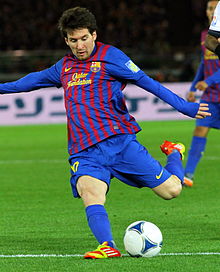
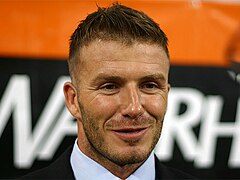
David Robert Joseph Beckham,
OBE[2] (born 2 May 1975)
[3] is an English former
footballer. He has played for
Manchester United,
Preston North End,
Real Madrid,
Milan,
Los Angeles Galaxy,
French Ligue 1 club
Paris Saint-Germain, and the
England national team for which he holds the appearance record for an
outfield player,
[4]
and also the first English player to win league titles in four
countries. He announced his intention to retire at the end of the
2012–13 Ligue 1 season on 16 May 2013, and on 18 May 2013, played his final game of his storied 20-year career.
[5]
Beckham's professional career began with Manchester United, making his first-team debut in 1992 aged 17.
[6] With United, Beckham won the
Premier League title six times, the
FA Cup twice, and the
UEFA Champions League in 1999.
[6] He then played four seasons with Real Madrid,
[7] winning the
La Liga championship in his final season with the club.
[8] In July 2007 Beckham signed a five-year contract with
Major League Soccer club Los Angeles Galaxy.
[9] While a Galaxy player, he spent two loan spells in Italy with AC Milan in 2009 and 2010.
In international football, Beckham made his England debut on 1 September 1996, at the age of 21. He was
captain for six years
[10][11] during which he played 58 times. He has 115 career appearances to date.
Beckham has twice been runner-up for
FIFA World Player of the Year[6] and in 2004 was the world's highest-paid footballer when taking into account salary and advertising deals.
[12] Beckham was the first British footballer to play 100
Champions League matches.
[6] When joining MLS in 2007 he was given the highest player salary in the league's history of US$6.5m per year.
[13][14][15][16]
He is married to
Victoria Beckham and they have four children. In 2009, the couple's joint wealth was estimated at £125 million
Early life
Beckham was born at
Whipps Cross University Hospital in
Leytonstone,
London,
England.
[18] He is the son of Sandra Georgina (née West; b. 1949), a
hairdresser, and David Edward Alan "Ted" Beckham (b.
Edmonton, London, July–September 1948), a kitchen fitter, who married at the
London Borough of Hackney in 1969.
[19][20] He regularly played football in Ridgeway Park,
Chingford, as a child, and attended Chase Lane Primary School and
Chingford Foundation School.
[21]
In a 2007 interview, Beckham said that, "At school whenever the
teachers asked, 'What do you want to do when you're older?' I'd say, 'I
want to be a footballer.' And they'd say, 'No, what do you really want
to do, for a job?' But that was the only thing I ever wanted to do."
[22] Beckham's maternal grandfather was Jewish,
[23] and Beckham has referred to himself as "half Jewish"
[24] and wrote in his autobiography "I've probably had more contact with Judaism than with any other religion".
[25] In his book
Both Feet on the Ground,
he stated that growing up he attended church every week with his
parents and his older sister, Lynne Georgina and younger sister, Joanne
Louise.
[26][27]
His parents were fanatical
Manchester United supporters who would frequently travel to
Old Trafford
from London to attend the team's home matches. David inherited his
parents' love of Manchester United, and his main sporting passion was
football. He attended one of
Bobby Charlton's football schools in
Manchester and won the chance to take part in a training session at
FC Barcelona,
as part of a talent competition. He played for a local youth team
called the Ridgeway Rovers – coached by his father, Stuart Underwood and
Steve Kirby. Beckham was a Manchester United mascot for a match against
West Ham United in 1986. Young Beckham had trials with his local club
Leyton Orient,
Norwich City and attended
Tottenham Hotspur's
school of excellence. Tottenham Hotspur was the first club he played
for. During a two-year period in which Beckham played for
Brimsdown Rovers' youth team, he was named Under-15 Player of the Year in 1990.
[28]
He also attended Bradenton Preparatory Academy, but signed schoolboy
forms at Manchester United on his 14th birthday, and subsequently signed
a
Youth Training Scheme contract on 8 July 1991.
Club career
Manchester United
Beckham was part of a group of young players at the club who guided the club to win the
FA Youth Cup in May 1992, with Beckham scoring in the second leg
[29] of the final against
Crystal Palace. He made his first appearance for United's first-team that year, as a substitute in a
League Cup match against
Brighton & Hove Albion,
and signed his first professional contract shortly afterwards. United
reached the final of the Youth Cup again the following year, with
Beckham playing in their defeat by
Leeds United,
and he won another medal in 1994 when the club's reserve team won their
league, although he did not play in any first team games that season.
On 7 December 1994, Beckham made his
UEFA Champions League debut, scoring a goal in a 4–0 victory at home to
Galatasaray
in the final game of the group stage. However, this victory was of
little use as they finished third out of four in their group behind
FC Barcelona on goal difference.
Preston North End (loan)
He then went to
Preston North End on loan for part of the
1994–95 season to get some first team experience. He impressed, scoring two goals in five appearances, notably scoring directly from a
corner kick.
[30]
Return to Manchester United
Beckham returned to Manchester and finally made his
Premier League debut for Manchester United on 2 April 1995, in a goal-less draw against
Leeds United. He played four times for United in the league that season, as they finished second behind
Blackburn Rovers and missed a third successive Premier League title by a single point. He was not in the squad for United's
FA Cup final clash with
Everton on 20 May, which they lost 1–0 and were left without a major trophy for the first time since 1989.
United manager
Sir Alex Ferguson
had a great deal of confidence in the club's young players. Beckham was
part of a group of young talents Ferguson brought into United in the
1990s (known as "
Fergie's Fledglings"), which included
Nicky Butt and
Gary and
Phil Neville. When experienced players
Paul Ince,
Mark Hughes, and
Andrei Kanchelskis
left the club after the end of the 1994–95 season, his decision to let
youth team players replace them instead of buying star players from
other clubs (United had been linked with moves for players including
Darren Anderton,
Marc Overmars, and
Roberto Baggio,
but no major signings were made that summer), drew a great deal of
criticism. The criticism increased when United started the season with a
3–1 defeat at
Aston Villa,
[31]
with Beckham scoring United's only goal of the game; however, United
won their next five matches and the young players performed well.
Beckham swiftly established himself as United's right-sided
midfielder (rather than a right-winger in the style of his predecessor
Andrei Kanchelskis) and helped them to win the Premier League title and
FA Cup double that season, scoring the winner in the semi-final against
Chelsea and also provided the
corner that
Eric Cantona
scored from in the FA Cup Final. Beckham's first title medal had, for a
while, looked like it would not be coming that season, as United were
still 10 points adrift of leaders
Newcastle United at the turn of the new year, but Beckham and his team-mates had overhauled the
Tynesiders at the top of the league by mid March and they remained top until the end of the season.
Despite playing regularly (and to a consistently high standard) for
Manchester United, Beckham did not break into the England squad before
Euro 96.
[32]
At the beginning of the
1996–97
season David Beckham was given the number 10 shirt that had most
recently been worn by Mark Hughes. On 17 August 1996 (the first day of
the
Premier League season), Beckham became something of a household name when he scored a spectacular goal in a match against
Wimbledon. With United leading 2–0, Beckham noticed that Wimbledon's goalkeeper
Neil Sullivan
was standing a long way out of his goal, and hit a shot from the
halfway line that floated over the goalkeeper and into the net.
[33] When Beckham scored his famous goal, he did so in shoes custom-made for
Charlie Miller ("Charlie" embroidered on boots), which had been given to Beckham by mistake.
[34] In a UK poll conducted by
Channel 4 in 2002, the British public voted the goal No.18 in the list of the
100 Greatest Sporting Moments.
[35]
During the 1996–97 season, he became an automatic first-choice player
at United helping them to retain the Premier League championship, and
being voted
PFA Young Player of the Year by his peers.
[36]
On 18 May 1997, Eric Cantona retired as a player and left the coveted
number 7 shirt free, and with Teddy Sheringham arriving from Tottenham
Hotspur as Cantona's successor, Beckham left his number 10 shirt for
Sheringham and picked up the number 7 jersey.
United started the
1997–98 season well but erratic performances in the second half of the season saw United finish second behind
Arsenal.
[37]
In the
1998–99 season, he was part of the United team that won
The Treble of the Premier League, FA Cup and
Champions League,
a unique feat in English football. There had been speculation that the
criticism that he had received after being sent off in the World Cup
would lead to him leaving England, but he decided to stay at Manchester
United.
To ensure they would win the Premier League title, United needed to
win their final league match of the season, at home to Tottenham Hotspur
(with reports suggesting that the opposition would allow themselves to
be easily beaten to prevent their deadly local rivals
Arsenal
from retaining the title), but Tottenham took an early lead in the
match. Beckham scored the equaliser and United went on to win the match
and the league.
Beckham played centre-midfield in United's win over
Bayern Munich in the
1999 UEFA Champions League Final, since United's first string centre-midfielders Paul Scholes and
Roy Keane
were suspended for the match. United were losing the match 1–0 at the
end of normal time, but won the trophy by scoring two goals in injury
time. Both of the goals came from corners taken by Beckham. Those
crucial assists, coupled with great performances over the rest of the
season, led to him finishing runner up to
Rivaldo for 1999's
European Footballer of the Year and
FIFA World Player of the Year awards.
Despite Beckham's achievements in the 1998–99 season, he was still
unpopular among some opposition fans and journalists, and he was
criticised after being sent off for a deliberate foul in Manchester
United's
World Club Championship match against
Necaxa.
It was suggested in the press that his wife was a bad influence on him,
and that it might be in United's interests to sell him,
[38] but his manager publicly backed him and he stayed at the club. During the 1999–2000 season, there was a talk of a transfer to
Juventus in Italy, but this never happened.
Beckham helped United retain the Premier League title in
1999–2000 by an 18-point margin – after being pushed by
Arsenal
and Leeds United for much of the season, United won their final 11
league games of the season, with Beckham scoring five goals during this
fantastic run of form. He managed six league goals that season, and
scored eight goals in all competitions.
By the early 2000s, the relationship between Ferguson and Beckham had
begun to deteriorate, possibly as a result of Beckham's fame and
commitments away from football. In 2000, Beckham was given permission to
miss training to look after his son Brooklyn, who had
gastroenteritis, but Ferguson was furious when
Victoria Beckham
was photographed at a London Fashion Week event on the same night,
claiming that Beckham would have been able to train if Victoria had
looked after Brooklyn that day. He responded by fining Beckham the
maximum amount that was permitted (two weeks' wages – then £50,000) and
dropping him for a crucial match against United's rivals
Leeds United. He later criticised Beckham for this in his autobiography, claiming he had not been
"fair to his teammates"[39] Beckham had a good season for his club, though, and helped United to win the Premier League by a record margin.
"He was never a problem until he got married. He used to go into work
with the academy coaches at night time, he was a fantastic young lad.
Getting married into that entertainment scene was a difficult thing –
from that moment, his life was never going to be the same. He is such a
big celebrity, football is only a small part."' – Alex Ferguson speaking
about Beckham's marriage in 2007.[40]
He was a key player in United's third successive league title in
2000–01
– only the fourth time that any club had achieved three league titles
in a row. He scored nine goals that season, all in the Premier League.
On 10 April 2002, Beckham was injured during a Champions League match against
Deportivo La Coruña, breaking the second
metatarsal
bone in his left foot. There was speculation in the British media that
the injury might have been caused deliberately, as the player who had
injured Beckham was Argentine
Aldo Duscher, and
England and
Argentina were due to meet in that year's World Cup.
[41]
The injury prevented Beckham from playing for United for the rest of
the season and they missed out on the Premier League title to Arsenal
(also being knocked out of the
Champions League by
Bayer Leverkusen
on away goals in the semi-finals), but he signed a three-year contract
in May, following months of negotiations with the club, mostly
concerning extra payments for his image rights. The income from his new
contract, and his many endorsement deals, made him the highest-paid
player in the world at the time.
[42]
Despite the injury, 2001–02 was arguably Beckham's best season as a
United player; he scored 11 goals in 28 league games, and a total of 16
goals in 42 games in all competitions, the best tally of his career.
Following an injury early in the
2002–03 season, Beckham was unable to regain his place on the Manchester United team, with
Ole Gunnar Solskjær
having replaced him on the right side of midfield. His relationship
with his manager deteriorated further on 15 February 2003 when, in the
changing room following an
FA Cup defeat to Arsenal, a furious Alex Ferguson threw
[43][44][45][46][47] [48][49] or kicked a
boot
that struck Beckham over the eye, causing a cut that required stitches.
The incident led to a great deal of transfer speculation involving
Beckham, with
bookmakers offering odds on whether he or Ferguson would be first to leave the club.
[50]
Although the team had started the season badly, their results improved
greatly from December onwards and they won the league, with Beckham
managing a total of 11 goals in 52 games in all competitions.
He was still a first-choice player for England, however, and was appointed an
Officer of the Most Excellent Order of the British Empire (OBE) for services to football on 13 June 2003.
[51]
Beckham had made 265 Premier league appearances for United and scored
61 goals. He also made 81 Champions league appearances, scoring 15
goals. Beckham won six Premier League titles, two FA Cups, one
European Cup,
one Intercontinental Cup, and one FA Youth Cup in the space of 12
years. By this stage, he was their joint second longest serving player
behind
Ryan Giggs (having joined them at the same time as
Nicky Butt,
Gary Neville and
Paul Scholes).
Real Madrid
As the summer 2003 transfer window approached, Manchester United appeared keen to sell Beckham to
Barcelona[52] and the two clubs even announced that they reached a deal for Beckham's transfer,
[53] but instead he joined reigning Spanish champions
Real Madrid for €35 million
[54] on a four-year contract as the latest of the
galáctico signings by club president
Florentino Pérez. The news came as a bitter pill to the newly elected Barça president
Joan Laporta, who based much of his presidential campaign precisely on signing Beckham.
[55]
Though announced in mid-June, the transfer was completed on 1 July
2003, making him the third Englishman to play for the club after
Laurie Cunningham and
Steve McManaman.
Following a successful medical on 2 July, Beckham was unveiled in front
of 500 accredited journalists from 25 countries at Real's basketball
facility, where he was handed the famous white shirt by club legend
Alfredo di Stéfano.
[56]
Although Beckham had worn the number seven shirt for Manchester United
and England, he was unable to wear it at Madrid as it was currently
assigned to club captain
Raúl. The Englishman decided to wear number 23 instead, citing his admiration of basketball player
Michael Jordan, who also wore the number 23 shirt, as the reason behind his decision.
[57]
In the week before Beckham presentation, Real named
Carlos Queiroz
as their new head coach, meaning that Beckham got reunited with a
familiar face upon arriving to Madrid since Queiroz spent the previous
season as Alex Ferguson's assistant at Manchester United. In late July
2003, the club went on a tour of the Far East as part of the pre-season
training, but also to cash in on Beckham's huge marketing appeal in Asia
where he enjoyed tremendous following. Real's brand recognition in that
part of the globe was already well established as the club made
financially successful trips to Asia during previous off-seasons,
however the presence of global marketing icon such as Beckham made this
particular tour a financial smash for
los Merengues.
[58]
Shortly after his Real switch, Beckham also ended his relationship with agent Tony Stephens of
SFX Europe
who had guided him through his career up until this point, including
helping to engineer Beckham's move from Manchester to Madrid. Beckham
signed on with
Simon Fuller and his company
19 Entertainment that already managed the career of David's wife Victoria.
[59] Beckham also appointed close friend
Terry Byrne to be his personal manager.
[13][60]
In late August 2003, Real Madrid won the
Spanish Super Cup over two legs versus
RCD Mallorca,
with Beckham scoring the final goal in a 3–0 return leg win at home,
thus setting the stage for the start of the league season. Playing on a
star-laden team along with
Zinedine Zidane,
Ronaldo,
Luis Figo,
Roberto Carlos, Raúl,
Iker Casillas,
etc., Beckham did not require much time to settle in, scoring five
times in his first 16 matches (including a goal less than three minutes
into his La Liga debut). Queiroz mostly favoured the adaptable 5–3–2
formation with two fullbacks
Michel Salgado
and Roberto Carlos often joining the attack down the wings, while
Beckham quickly found a regular playing spot on the right of the
three-man midfield alongside Zidane and Figo.
[61]
Real Madrid were runners-up in the
Copa del Rey,
were knocked out of the UEFA Champions League at the quarter-final
stage and finished the league season in fourth place, meaning the team,
whose president Pérez expected them to win either the Spanish league or
the Champions League each season, did not match expectations.
In July 2004, while Beckham was in pre-season training in Spain, an
intruder scaled a wall at the Beckham home while carrying a can of
petrol.
Victoria and their children were in the house at the time, but security
guards apprehended the man before he reached the house.
[62]
The league season began with new head coach
José Antonio Camacho
behind the bench, but he ended up lasting only three matches, handing
in his resignation as Real dropped to eighth spot in the La Liga
standings. Camacho's assistant
Mariano García Remón
took over on temporary basis as Real leadership scrambled to find a
permanent replacement. Beckham made more headlines on 9 October 2004
when he admitted intentionally fouling
Ben Thatcher in an England match against
Wales in order to get himself booked. Beckham was due to receive a one-match suspension for his next
caution,
and had picked up an injury, which he knew would keep him out of
England's next match, so he deliberately fouled Thatcher in order to
serve his suspension in a match that he would have had to miss anyway.
The Football Association asked Beckham for an explanation of his actions and he admitted that he had "made a mistake" and apologised.
[63] He was sent off shortly afterwards, this time in a league match for Real Madrid against
Valencia. Having received a
yellow card,
he was judged to have sarcastically applauded the referee and was given
a second yellow card, causing an automatic dismissal, although the
suspension was cancelled on appeal two days later.
By Christmas 2004, with the team sitting in second league spot, García Remón was gone as
Vanderlei Luxemburgo
became the new head coach. However, the well-traveled Brazilian failed
to inspire the team to the title as Real again finished the season in
the runner-up spot.
On 3 December 2005, Beckham was sent off for the third time that season in a league match against
Getafe CF. One day later Luxemburgo got the axe and was replaced with
Juan Ramón López Caro. By the end of that season, Beckham led La Liga in number of assists.
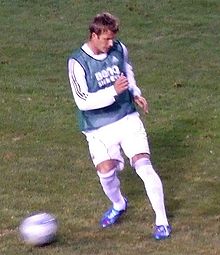
Warming up with Real Madrid in August 2006
During the season, Beckham established football academies in Los
Angeles and east London and he was named a judge for the 2006 British
Book Awards.
[64]
Real Madrid finished second to Barcelona in the 2005–06 La Liga, albeit
with a large 12-point gap, and reached the last 16 only in the
Champions League after losing to
Arsenal. The season also marked the end of an era for the club as Pérez resigned his president post in January 2006 with
Vicente Boluda named as replacement on interim basis until the end of the season.
The summer 2006 off-season marked a turbulent time as club president elections were held.
Ramón Calderón
became the new Real president. As expected, none of the club officials
that served under the previous president were kept, including head coach
López Caro.
Initially out of favour with newly arrived head coach
Fabio Capello, Beckham started only a few games at the beginning of the season, as the speedier
José Antonio Reyes was normally preferred on the right wing. In the first nine matches Beckham started, Real lost seven.
On 10 January 2007, after prolonged contract negotiations, Real Madrid's sporting director
Predrag Mijatović
announced that Beckham would not remain at Real Madrid after the end of
the season. However, he later claimed that he was mistranslated and
that he actually said that Beckham's contract had not yet been renewed.
[65]
On 11 January 2007, Beckham announced that he had signed a five-year deal to play for
Los Angeles Galaxy
beginning 1 July 2007. On 13 January 2007, Fabio Capello said that
Beckham had played his last game for Real Madrid, although he would
continue to train with the team.
[66]
A few days later while speaking to the students at Villanueva
University Center in Madrid, club president Calderón said that Beckham
is "going to Hollywood to be half a film star", adding "our technical
staff were right not to extend his contract, which has been proved by
the fact that no other technical staff in the world wanted him except
Los Angeles".
[67]
However, about a month later, Capello backtracked on his earlier
statement, allowing Beckham to rejoin the team for the match against
Real Sociedad
on 10 February 2007. The player immediately repaid his head coach's
trust by scoring the equalising goal from a 27-yard free kick as Real
Madrid eventually recorded a 2–1 victory.
[68] In his final UEFA Champions League appearance for the club, Real Madrid were knocked out of the competition by
Bayern Munich at the
round-of-16 stage
(on the away goals rule) on 7 March 2007. The return leg against Bayern
was Beckham's 103rd match in the Champions League, at the time placing
him third on the all-time appearances list in the competition.

Beckham's last season in Real Madrid
On 17 June 2007, the last day of the La Liga season, Beckham started in his final match for the club, a 3–1 win over
RCD Mallorca, which saw them clinch the title from Barcelona. With Real down 0–1 Beckham limped off the field and was replaced by
José Antonio Reyes who scored two goals leading the team to that season's
La Liga title,
their first since Beckham had signed with them and 30th overall in
club's history. Although Real and Barca both finished level on points,
Madrid took the title because of superior head-to-head record, capping a
remarkable six-month turnaround for Beckham. With his wife and children
along with celebrity friends
Tom Cruise and
Katie Holmes
watching from a luxury box at Bernabeu Stadium, it was only Beckham's
second piece of silverware since he joined the famous club.
Towards the end of the season, as Beckham was getting back into
Capello's good books after successfully fighting his way back into the
first team,
Real Madrid announced they would try to untie his transfer to LA Galaxy, but were ultimately unsuccessful.
[69]
Several weeks before Beckham's scheduled arrival to the United States,
Real's management contacted LA Galaxy's ownership group about
reacquiring the player, but were quickly turned down.
[70]
A month after the conclusion of Beckham's Real career,
Forbes
magazine reported that he had been the party primarily responsible for
the team's huge increase in merchandise sales, a total reported to top
US$600 million during Beckham's four years at the club.
[71]

 Brazil